 Looking into the question of pre-rinsing or not rinsing for the dish-washer (next post) I realise how much we dislike change. We want something different, as long as it reminds us of what we know. Handy Hints are now called hacks, I believe. Larry David, co-writer of the sit-com Seinfeld, gave me (not personally) two of the best life hacks ever, which I have used regularly to my advantage ever since.
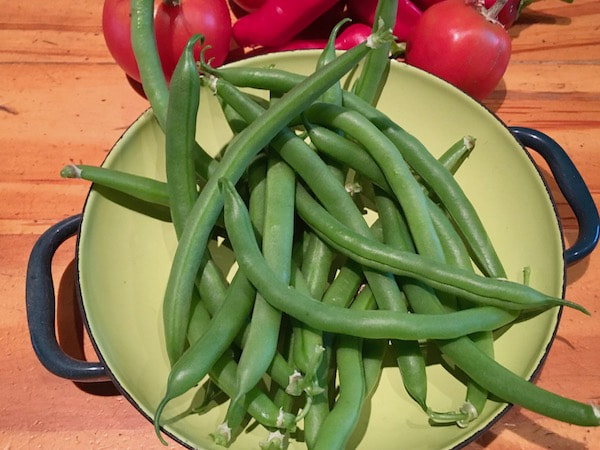
Yes, I aim to disturb, to question. But a suggestion comes from a simple observation. It is not a rule, not an edict, not an injunction nor an ultimatum. I've suggested for example, a different way to arrange cheese on a plate (11th Jan, 2018). A friend commented archly that a famous chef on TV (Celebrity Chef, Master Chef, Chef Extraordinaire, TV chef, not sure which) had not done this. (Perhaps I could advise him; he might like my idea.) But it's not a rule. Carry on serving your cheese on hefty 15 kilo planks of Huon Pine, if you wish. So before I set off to delve into the murky world of unwashed dishes, I'll leave you with the simplest and possibly the best cooking tip I've ever received. The major-domo at Orlando Winery's city headquarters (now a row of high-rise appartments) was ultra conservative, a committed believer in the crisp white shirt, polished hair, and the dignity of service. He was a master of the malapropisms. (He was "rape-able" when asked to change a table setting. Small wineries were "petique".) But I think warmly of Maurie whenever I cook green beans. Have the water at a rolling boil. Add half a teaspoon of salt, half a teaspoon of olive oil, throw in the beans for six minutes. Drain and serve.
The oil is the miracle. It leaves a glossy film on the beans - beautiful. (Let me know.) Share some simple tips. (Comments 👇🏾 in blue below.)
8 Comments
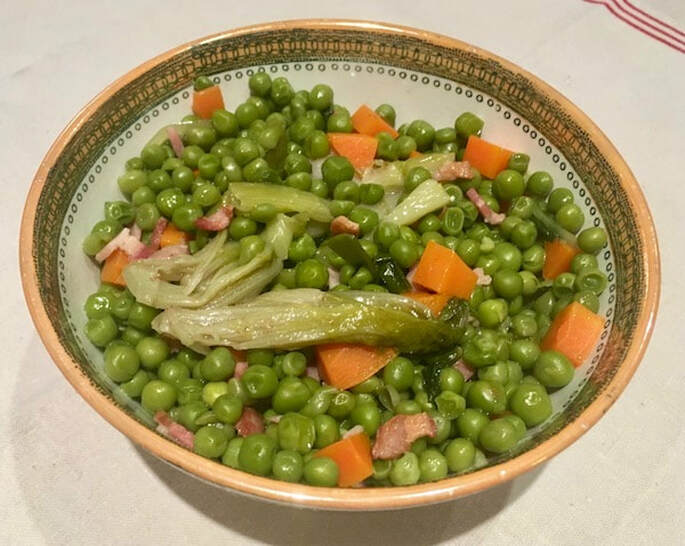 What a retro image! So old-fashioned, so off-trend, so "vintage" it's nearly cool. Whatever, it's my favourite dish of vegetables. I made this with 500 gm of peas and I could have sat down on a muffet and eaten the whole lot with a runcible spoon.
They are peas, petits pois, done my mother's way where there's no such thing as crunchy, under-cooked vegetables. I never eat a plain, boiled, six-minute pea. As a teenager, as you do, I looked into existentialism, positivism, rationalism, nihilism, humanism, atheism, anarchy and dialectics. At some stage, I was drawn to Charles Fourier (1772 - 1837 Paris), a Utopian Socialist. He believed the transformation of labour into pleasure would lead to harmony and mutual consideration. I particularly liked his ideas on children, (for whom he recommended a diet of preserved peaches and sweet white wine). He saw children as naturally industrious and it was simply a matter of channelling their energy. (Their passion for filth made them perfect rubbish collectors.) The best occupation to utilise their love of activity and rummaging was the shelling and sorting of peas! Shelling peas is calm and "mesmerising", perfect for watching Dr Phil. Sadly, whether from a farmers' market or a supermarket, whether organic, macrobiotic, biodynamic, bucolic or hydroponic, they are disappointing. Fourier's peas would have been shelled and cooked within minutes of being picked from the vine. Our peas in the pod can be days before arriving at a greengrocer's shelf, then days before being sold, only to hang around a bit longer before being prepared in one's kitchen. As soon as pods are picked, the sugar in the peas begins converting to starch resulting eventually in "bullets". (Sorry, but...) Are frozen peas better than fresh? IMO, yes, especially if you choose "baby" peas. There are no other vegetables that benefit as peas do from snap freezing. Petit pois à la française (Peas in the French manner) 4 people - unless you want to eat them all yourself 500gm frozen "baby" peas 50 gm diced bacon (very, very optional) 50 gm -70gm sliced onion or spring onions, keeping some of the green 50 gm diced carrot (optional) 60-80 gm lettuce, either leaves or heart seasoning A very flexible recipe, of course. If not using bacon, use the larger amount of onion, for the umami. If using spring onions, cut into 7 cm pieces, using the white and some of the green. It's nice to have a couple of small lettuce hearts but sliced outer leaves you don't know what to do with, work very well.
The question remains however. How does one eat peas? I'm researching the answer. Comment below or like 👍🏼 [email protected] facebook.com/itsnotthelastsupper 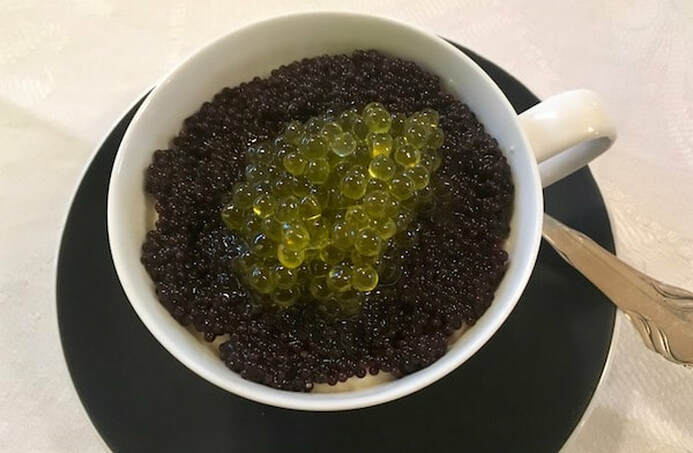 Cauliflower Mouse with Lumpfish Roe (caviar). Served in a cup and the lumpfish roe highlighted by some "olive oil pearls", a jar of which I discovered during my cupboard-decluttering phase. The "pearls" didn't catch on, I expect, because I haven't seen them around lately. (Recipe below) ooooooooooo Planning a meal is like working a play. There's the story, the cast (of ingredients), the audience and the props. One feels privileged to sit at Liz's table. She is an artist and has an eye for an eccentric, dramatic but beautiful and comfortable table setting. She and her partner/husband are generous and funny. But darling Liz has been facing a dental challenge. To be blunt, the new dentures look marvellous, but they are not fully "acclimatised". That's the story. We ate together and the challenge was to prepare a dinner with no hard surfaces, no snapping, no crunching, no chewing. Four courses had to be delicious, unctuous, nourishing to mind and body - and soft. We had... A few chilled oysters with a glass of fizz, then sat down to...
Later, I pondered for a long time on how much I rely on cream and eggs. Can't get enough of them. Images and recipes follow. We won't always be faced with dental challenges but each dish would fit nicely amongst others with crunch. (Ideas for pea soup and cauliflower mousse from Yves Camdeborde of the Relais du Comptoir, place de l'Odéon, Paris.) 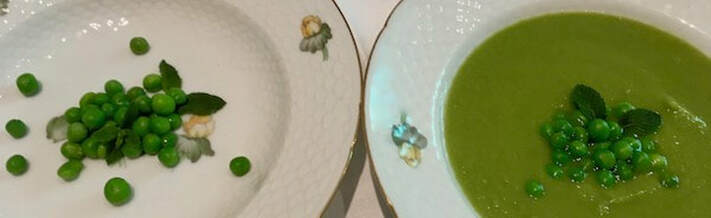 Chilled Pea Soup with Mint. (Recipe - See post "Dinner Without a Stove" 17/1/2018) For 6 people, I use 750gm of frozen peas and reserve 600ml of cooking liquid The "hook" in this recipe is that it contains only peas and water (if you don't count the mint and olive oil). I repeat, it's just peas and water and amazing. Why do I use frozen peas? Next post. Cauliflower Mousse with Lumpfish Roe (image above) For 4-6 small pots 300 gm cauliflower 200-220 ml of whipped cream 150 gm (approx) of lumpfish roe, about 2 small pots Seasoning and a little olive oil.
Note: Feel free to top the mousse with Beluga caviar if you wish! LOL! 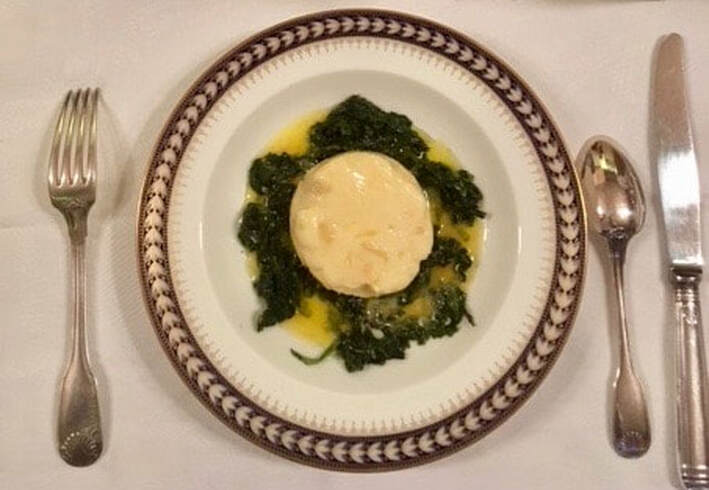 Prawns on Creamed Spinach with Beurre Blanc. For 8 small ramekins 500gm uncooked, peeled prawn meat 500 ml single cream 2 egg whites
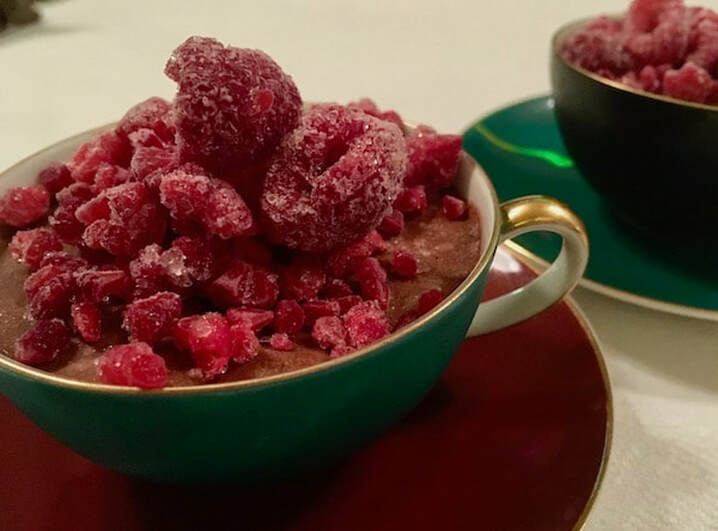 Chocolate Mousse with Frozen Raspberries
The legendary Elizabeth David offered a recipe that couldn't be simpler. It was originally measured in ounces, of course. For each person... 1 ounce of chocolate (dark, no more than 70%, please) 1 egg 1 tbsp flavouring e.g.coffee, rum etc. Metric, this translates as... For each person... 30gm chocolate (dark, no more than 70%, please) 1 egg 1 tbsp flavouring e.g.coffee, rum etc.
Tiny, because the mousse is rich and we like "pudding" but we don't need much. Comment below or like 👍🏼 [email protected] facebook.com/itsnotthelastsupper Sauceboats - they don't pour, they're not meant to pour. Add a spoon, easy and no drips. European sauceboats have attached under-plates. Very sensible. If you can, have two per table. If you're still hunting around the junk shops, use a bowl with a spoon (rather than a jug). 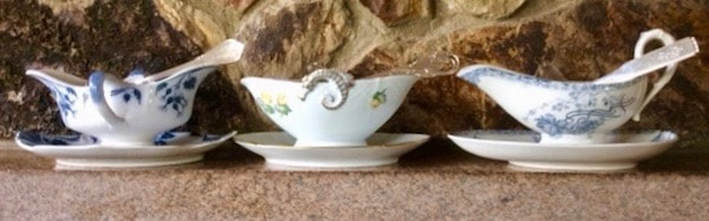 I've long thought that serving fish well, basically boils down to having a lemon and to knowing two sauces - beurre blanc and sauce vièrge (see post 15/12 2018) There has been a lot of feed back on the Coulibiac (November 2018 post), with promises to make one and send photos! In that case, you'll need to try a beurre blanc, the perfect sauce to serve along side. This is not a sauce for fat phobics and margarine eaters. If you think you'd better only have a small serve, perhaps this is not the sauce for you. This sauce relies on technique and understanding. Somehow you are making oil and water emulsify. It's magic. BUT if my kitchen phobic partner can do it, anyone can. It can be made with red wine - nice with steak - and of course it is then a beurre rouge. Beurre Blanc (a tidy serve for 6 to 8) ½ cup white wine 1 spring onion or 1 tbsp finely chopped shallots dash of cream ** 250 gm butter seasoning to taste lemon juice to taste Use a saucepan with a handle so you can easily lift it on and off the heat to monitor the heating temperature. Unfortunately the sauce should be made no earlier than 3/4 hour before serving. Let this be the only last minute thing you have to worry about. Any left over can be eaten the next day spread on toast. **Cream doesn't feature in the classic recipe but Gabriel Gaté suggested it to me as added protection against the sauce splitting.
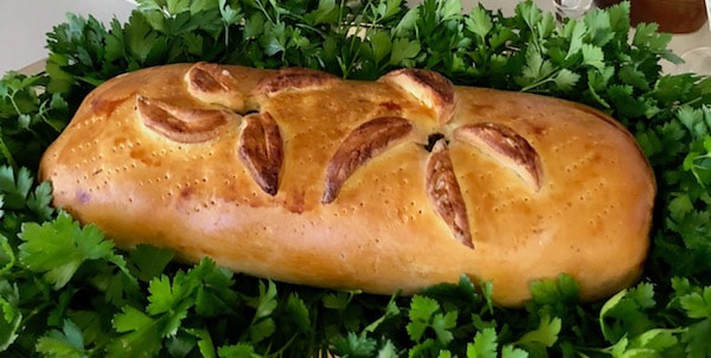 New home page - an impressive Coulibiac. This is a free-form pie of salmon, rice, mushrooms and dill, wrapped in a brioche pastry, made to feed eight to ten. Originally Russian (Koulibiaka), it was refined for the classic French repertoire (see Escoffier) when French culture had a craze for all things Russian, such as ballet, samovars and Fabergé. (A Koulibiaka is in essence a large pirogi and might contain cabbage, a humble ingredient rare, if ever, seen in la cuisine française classique.) My niece and I had a session recently to re-acquaint ourselves with its construction. Making a Coulibiac is certainly a "project" but an easy one, prepared ahead, cooked or re-heated for serving. Any stress from preparing its various components is compensated for by its easy (and stress free) finale. It's a fully integrated course, protein, vegetables, carbs all in a neat package! With a butter sauce or sour cream on the side, it's all you need. When I had my restaurant, I encouraged my staff to hunt out old copies of the wonderful Time-Life Foods of the World series - (second-hand book stores, junk shops, garage sales). Anyone who dumped his or her copies in the eighties is sure regretting it now! The Classic French Cooking volume gives three A4 pages of dense recipe and instructions for Coulibiac, photographs extra. The salmon is poached in cream first, dill pancakes are prepared and used to wrap the layered filling, every layer is clearly defined, a brioche mousseline encases the whole. STOP! Our version is the "Readers Digest" of recipes and loses nothing in looks and flavour. The melding of ingredients in a Coulibiac is a definition of "synergy". It's an old-fashioned recipe. It's an entire meal. Craig Claiborne, restaurant critic, food writer and editor of the N.Y. Times said in 1976 "To my mind, it's the world's greatest dish". It's a show stopper. Ours sits on an excessive bed of fresh flat leaf parsley - just because it was growing madly in the garden. Try it and let me know your results. Coulibiac (Will generously feed up to eight or more.) Filling - make this first Olive oil for cooking 250 gm mushrooms sliced 200 gm (1 cup) long grain rice 2 eggs, hard boiled 1 leek 1.5 kg salmon or ocean trout, skin off, fillet or pieces 1 – 2 tbsp chopped fresh dill (or 2 tsp dried) Seasoning
Brioche - make this the day of assembly 200 milk 3 eggs 1 tbsp dry yeast 1 tsp salt 1-2 tbsp sugar 550gm plain flour 80 gm butter, soft and cut into pieces Extra egg for egg wash Use the mixing bowl of a Kitchen Aid or large Magimix.
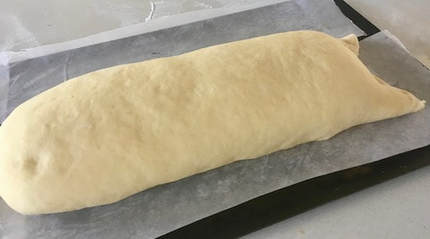 Close the ends neatly, tuck them under, cutting away any excess dough. Glaze the Coulibiac with the egg wash and prick it attractively all over with a fork. Now's the time to get creative, if you wish, with left over dough, decorating the top with leaves, flowers or fish. 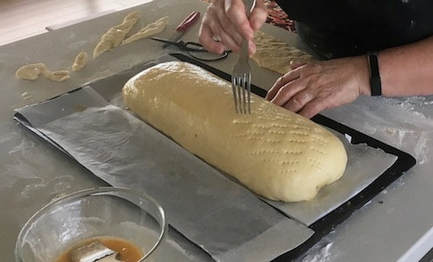 Place the Coulibiac in the refrigerator for 1/2 an hour or for several hours until you're ready to bake it. Allow about 40 minutes, 180˚C (fan) or until the pastry is nicely golden. Let it sit for 10 minutes before cutting and serving, having put it on an attractive oval platter. Prepare a melted butter sauce, a beurre blanc or a bowl of sour cream to be passed around. Cut the Coulibiac into slices about 2 cm thick and place in the centre of each plate. This can be done at the table. It's very rich. Second helpings may be possible. It needs nothing else, although green beans or asparagus would suit.
Let me know how you went. Do you need a beurre blanc recipe? Comment below. Left: The waterfall, Gullfloss Centre: Harpa - the Concert Hall and Convention Centre at Reykjavik. Right: Angelica, growing wild around Stokkseyri. We are finally in Reykjavik. It is busy with tourists, very noticeable in primary coloured anoraks. We walk around Harpa, the stunning concert hall, sitting right at the water’s edge, made like a honeycomb of glass. The anoraks are everywhere – red, blue, yellow, lime green – and I remind myself that we too are tourists filling the space, albeit dressed in tasteful black. He’s got the hand-knitted cardigan now, in natural dark brown wool, he’s had a brunch of skyr (served with lingonberries) and I’ve had the pickled sheep’s head (deliciously served as a terrine or brawn) with mustard and dark bread, so we decide to scarpa, hire a car for two days and head to the country. The first day we drive north east to Gullfoss, a massive waterfall (OK it’s not Niagara but it’s pretty spectacular and very loud). We have lunch at the nearby visitor centre and “family” restaurant, where the food is surprisingly good. RTV has the roast lamb (lots of sheep in Iceland) and I have a traditional dish – plokkfiskur - cod and potatoes in creamy white sauce with a dark brown “bread” cooked in the steaming hot earth. (I’m sure they’ve now found easier ways of cooking rúgbrauð!) Once home, I try out the recipe given to me in Iceland (see below) and find that it is indeed good with smoked salmon, lamb pâté, cheese, pickled herring or simply buttered for a tea or coffee break. The next day we have a magical drive south to the sea. We stop at Stokkseyri, population 400, watch birds dive for fish in the shallows, take a break at a little café in a charming wooden house. Here we discuss books with the lovely proprietor, in particular the Icelandic “noir” crime genre. She continues to knit between frothing cappuccinos. Travel for me is generally about food, traditions, art museums and shoe shops. (Shallow? I feel no shame.) Iceland however, is about landscape and puffins. Interesting trivia (from Wikepedia) -Each square km is shared by 3 people, 8 sheep, 100 puffins. It’s a sane country despite building plans being changed to accommodate settlements of elves (trolls) because some of the population believes in them - (democracy in action). It’s an ethical country with a VAT of 24% (except on food) which is noticeably spent on the comfort of its people. (The roads are a dream to drive). The financial crash of 2008 saw many stranded by dodgy deals and predictions. (Fishermen left their nets hoping to make billions.) Bankers and Financial Advisors complicit in the disaster were jailed, whereas in our country they would be retired on substantial "packages". 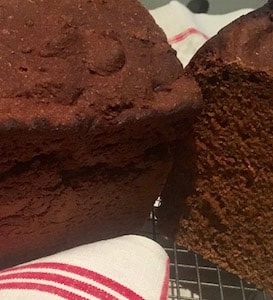 Rúgbrauð (Rye bread, a touch of sweetness, no yeast . VERY easy and delicious and keeps for days!) 1 1/2 cups dark rye flour 3/4 cups wholemeal or plain flour 2 tsp baking powder 1 tsp salt 1/2 tsp baking soda 1 cup buttermilk* 1/3 cup treacle or molasses 1 small loaf tin approx. 250cm x 100cm Prepare the tin by buttering it or using a baking spray. Stir together the buttermilk and treacle. Mix together all the other ingredients. Pour the milk mixture over the dry ingredients and blend everything together for a sticky dough. Fill the loaf tin. The tin should be deep enough to allow the bread to rise. Now for the tricky bit. The bread used to be cooked in a closed container for eight hours, buried in hot earth, giving it a dense crumb. You do not have a spring nearby. To create a sort of steamy atmosphere, cover the loaf tin with foil, crimping it loosely around the rim. Put the loaf tin in a baking dish half-filled with water (like a bain-marie). Bake at 120˚C for 4.5 hours. Remove from oven, un-mould and cool on a rack. *If you can't find buttermilk at the supermarket, plain milk will be fine. The acidity in the buttermilk works wonders with the baking soda as a raising agent. The Alphabet... You must be impressed by my mastery of and Þ- þ and Ð - ð. These are old runic letters once also used in old English and Norse. Þ– þ (upper and lower case) - The letter Thorn is always used at the beginning of a word but since it doesn’t exist outside Iceland and the Faroes, it’s hard to look up a town on Google maps that begins with Þ. It’s the sound of “th” as in Thor. Ð - ð (upper and lower case) is the letter Eth. It’s never found at the beginning of a word and is a “soft th” sound. (I can't actually tell the difference!) G in the middle or end of a word is not really sounded so with this information, can you pronounce Rúgbrauð? Good luck! Comments or suggestions below... 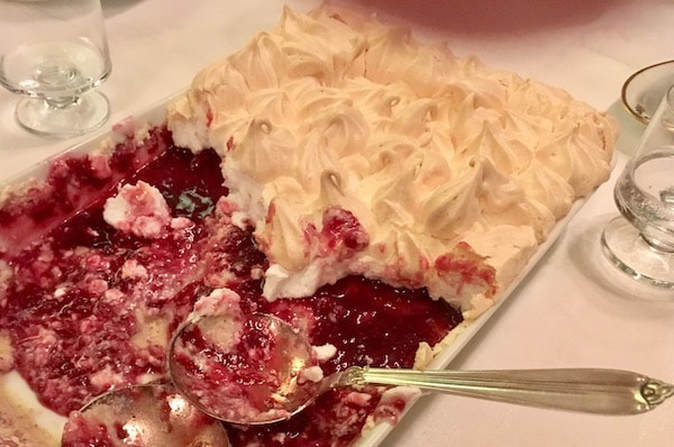 Above- Mary Berry's QUEEN'S PUDDING from "The Great British Bake-Off". We’re still thinking of Tony Bourdain. I’m lounging around while my partner reads out the funny bits (Medium Raw). Funny and acerbic, these are ideas all cooks and chefs relate to. He’s writing about real food, hospitality, conviviality, culture, all with a reminder that pleasure and sumptuousness are as important as restraint and simplicity. He loved excess and hated waste. In contrast, flipping through the TV channels recently, I caught a few moments of Master Chef, a show that purports to be about good food. Instead of warmth and friendship, the show promotes humiliation, suspense, aggression, fear and panic. It’s “Game of Thrones” in a kitchen. Worse can be said of My Kitchen Rules, which adds downright rudeness, plastic surgery disasters and bad table manners. I won’t elaborate on their bad suits. If asked, I’d probably accept a stint as guest judge on MC. The money could add an extension to the house, repaint the sitting room, add a few Iranian rugs to the collection. It could for heaven’s sake even get me a Rothko or pay Willy Nelson to sing at my birthday. But honestly, what was Prince Charles doing on the show? Was that a new low? Who pulled that off? Why did he do it? Did the stables need re-roofing? Did the organic garden at Highgrove need to be expanded?  The charismatic Lee Lin Chin is leaving (retiring?) the news desk at SBS. Beautifully spoken, her dress sense is exquisite with just enough eccentricity to balance style and good taste. Would she have time at least to help the image of the gentlemen from Master Chef and MKR – five of the worst-dressed men on TV? -The Great British Bake-Off I came to it late, I admit, but The Great British Bake-Off has entertained and inspired me. I even “binged” on six episodes in a row, one Sunday. Mary Berry – cookery writer, Paul Hollywood – master baker, Sue Perkins and Mel Giedroyc (comedians) host the show. Contestants work in a delightful marquee set in some bucolic corner of Britain. Their equipment is tastefully colour co-ordinated in pastel shades. They are put through a series of “challenges” – sponges, tarts, breads, scones, biscuits – but it’s all so civilized and calm, warm, friendly and encouraging. They all like each other. As an accomplished cook, I still learnt lots; about avoiding soggy bottoms, checking for yeast development, etc. (I had to get me one of them there automatic temperature checkers, by golly, and some better piping nozzles.) “Tear’n share” breads were a first for me as was the new “all in one method” of cake mixing. Works well on a Victoria sponge (which leads, of course, to the differences between a Victoria, a Génoise, a Madeira). I wasn’t happy with serrated knives cutting across cake racks nor with jumper sleeves pulled down to thumbs while cooking. I can’t believe that twice, salt was mistaken for sugar with disastrous results. The judges would criticize my love of dark pastry crusts - they prefer pale - and was it the British love of the double-entendre that gave so much attention to “nice buns”, “cream horns” and “soggy bottoms”? The BBC couldn’t believe its luck when the show went viral with most of the population glued to the finals. The Great British Bake Off – catch it somehow – catch it on youtube – and for a laugh, watch David Walliams and Joanna Lumley do their thing! https://www.youtube David Walliams Joanna Lumley  Queen’s Pudding
(based on Mary Berry’s recipe) This is spectacular and easy. *To prepare ahead of time, finish the custard and fruit part. Have the meringue whipped just before friends arrive. It will hold and can be “revived” with a light whisk before putting into the piping bag. ** If you have the privilege of eating this dessert, pour the cream AROUND your serve, not on top of it. (See Blog Post – “Respect” – 12/12/2017.) The chef has spent time cooking and presenting a lovely piece, with the meringue just right. Don’t dishonor it and cover it with cream. (The rugged individualists among us, of course, will do what they want.) I first made this for a friend who is seriously gluten intolerant. For the base, I used part blanched almond meal, part gluten-free breadcrumbs. It worked so now I suggest the almond meal every time. The recipe can be successfully adapted to the dish available. The pilluyvit dish in the photograph needed the recipe x 1.5. For the base 600 ml real milk (i.e. not low fat) 25 gm butter (plus some for buttering the dish) zest of one lemon (optional) 50 gm caster sugar 3 egg yolks 75 gm bread crumbs (or better still, 50 gm blanched almond meal & 25 gm breadcrumbs) Meringue: 175 gm caster sugar & the 3 egg whites Fruit: 500 gm frozen raspberries & 200 gm caster sugar Serve: pouring cream Preheat the oven to 170C / 325F Butter a 1.5 ltr (approx.) shallow oven-proof dish (one that will fit into a roasting tin as a bain-marie). Base: Warm the milk, butter and sugar. Whisk the egg yolks in a bowl and pour over the milk mixture. Add the lemon zest. Spread the breadcrumb mixture over the bottom of your dish. Pour over the milk mixture. Place this dish of “custard” in a roasting tin, half filled with warm water. Bake 20 – 25 minutes until set. Remove from bain-marie. Fruit: Meanwhile, place the raspberries and sugar in a saucepan and heat gently for about 4 minutes or until you have a loose jam-like consistency. Pour / spread over the custard. Meringue*: Whisk the egg whites until fairly stiff. Gradually add the sugar and continue whisking until mixture is stiff and shiny.* (See above.) Spread the meringue over the fruit, creatively forming peaks or better still, put meringue into a piping bag and pipe attractively. Bake: Return to the oven (150˚C) for 20-25 minutes until the top is lightly brown and crisp. Serve**: immediately with pouring cream.** Comments below ... 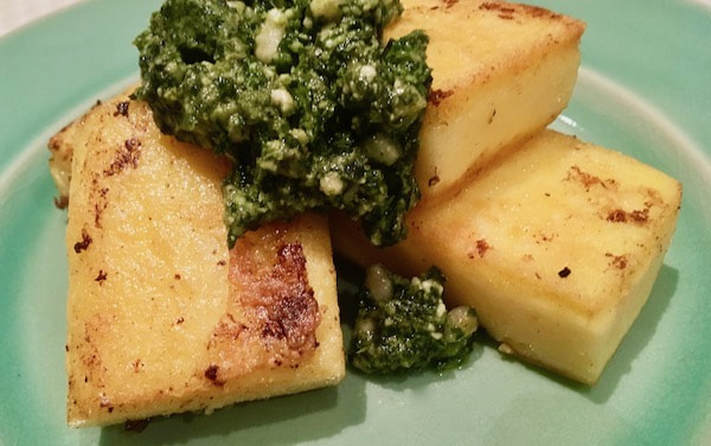 Crisp polenta & chunky pesto - easily helped by the Thermomix Someone has asked about the Thermomix, (wondering why, I presume, I didn’t call on its services when I was “without stove” for five days?) A few years ago, after an extremely busy time at the restaurant leading up to the end of the year, I felt I needed a personal present and bought a Thermomix. I love it, but wouldn’t recommend it to everyone. Here are my pros and cons. In case you don’t know, the Thermomix is a combination food-processor – blender with built-in cooking ability. In restaurants you would need a bank of them. (The erstwhile El Bulli had six, I believe.) They are definitely for home use. There have been claims against Thermomix for accidents while using. This I put down to the fact that it’s very powerful and needs to be sold only to sensible, intelligent people who will treat its power with respect. It’s large and takes up lots of bench space. It’s quite noisy in operation. You can have faith in its German engineering. I’ve heard raves and sighs at how good it is for baby food. It makes marvelous baby food but then again, babies grow up. All the food prepared in it is “sloppy” food. My uses
Frankly I could love it for the polenta and hollandaise alone but is the price tag worth it to you? Perhaps I haven't explored the suggestions of the on-line "community" enough.
I’m told about someone who knows someone whose niece knows someone else who uses it all the time. Not sure what that means but it does tell me that, all the time, they’re eating sloppy food. If you’ve got the bench space, can blow a couple of thousand or are simply bored, you might look forward to the polenta. I’d recommend an ice-cream making machine or an upgrade on your Breville Whiz if you don’t have “the really good food processor”. Thermomix Polenta (4 -6 depending on how you use it) This works very quickly so have all ingredients ready to hand.
Add
Pour immediately into a bowl and serve or better still, pour into a dish approx. 150cm x 270cm. Cool, cut into squares or slices, brown in butter and serve. *Polenta can be "enriched" by using part water part stock or part water part milk. **There is no salt because the Parmesan is salty. For next time, season with a little salt if you think it's needed. Nutmeg is also nice. Thermomix Pesto Throw into the Thermomix bowl...
Scrape into a bowl. Wonderful fresh but will keep for several weeks in the refrigerator. Comments - see below to add... 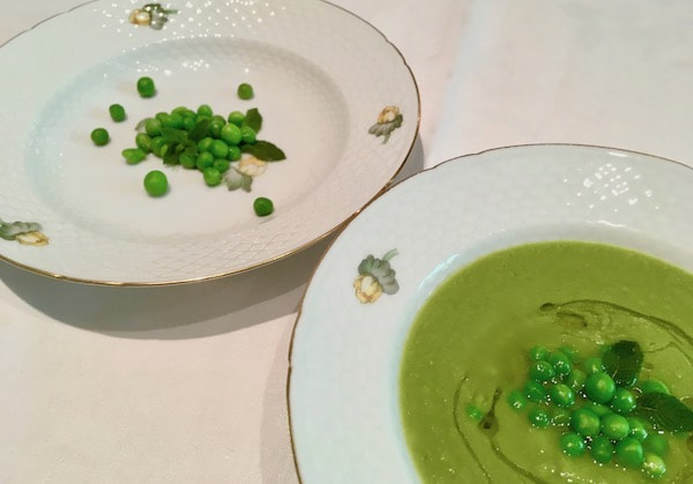 Started off on the right foot with my 2018 resolutions - the important one being to regularly keep up with friends. We had dinner here the other night on a ludicrously hot day – 40˚C. Furthermore, I wasn’t sure whether the new stove might land unannounced or whether the old one would behave. So we did it all cold. Here’s the menu.
Iced pea and mint soup (So, so pure) Eggs mayonnaise – our eggs, boiled, yolks just firm, masked in real mayonnaise. Not the sweet stuff in a jar, I made it. Each half had an anchovy fillet and tiny capers. Whoops – forgot to make a main course Cheese, grapes and a fougasse* – (Cheese - see previous post.) Pavolva with strawberries, passionfruit and cream – large and lavish. I macerated the strawberries for the day with some castor sugar and kirsch. Whipped the cream. Licorish & red berry tea and some too, too delicious sweeties from Iran (praline and cardamom) brought by Angela and Hossein Valamanesh and chocolate fudge brought by Mirna & Ian. Now, this menu was cold, was prepared well beforehand, was easy to serve, immensely satisfying and totally non threatening, even if I say so myself. (I bought the Pavlova base, for heaven’s sake, leaving the guests to boast about how they all made theirs from scratch.) Try this soup, if you like chilled soup. You won't believe it. It’s beyond zen. Iced pea and mint soup - easy for 6, and a little over, in case. 1 kilo frozen baby peas**. Water Mint leaves 1-2 per person Seasoning & 2 tbsp of EVO (optional) Place peas, just covered in water, in a large saucepan. Bring to the boil, lower heat a little and simmer, uncovered for about 2 minutes. In the meantime, have ready a deep bowl in which you place your colander. This is VERY important because you have to save the cooking liquid. (It's so easy to tip it down the sink.) Have also another bowl with a tray of ice cubes. Drain the peas into the colander, reserving all the cooking liquid. Dump the peas onto the ice cubes and toss about to quickly chill them, keeping them bright green. Set aside 6 generous tablespoons of peas, covered in a small bowl. Measure out 800mls of pea cooking liquid. When cool enough to handle, "blitz" the peas, adding the liquid bit by bit, until you have a creamy consistency. This must be done thoroughly to obtain a totally smooth purée, (otherwise, you might have to sieve it, which would be a shame). Season the soup with salt. You will need to balance the sweetness of the peas. Chill. Making it the day before (if you're going to be busy) will not "tarnish" the colour. To serve - check the consistency of the soup. It should be creamy not what I call hippy-soup. (See next post.) Sliver the mint leaves not too long before serving so they don't blacken. Give each guest a bowl with the reserved peas and some mint in the centre. Serve the soup (over which you have poured a thin stream of EV olive oil) in a tureen, at the table. I had this first in Paris served in a martini glass with a small spoon. Set aside a larger quantity of peas and hold back the pea liquid to obtain a heavier purée. I matched the plates to the peas - Bing & Grondhal, Erantis. These from around 1955 but the design carried through from 30s to the mid 70s. *Fougasse - a flat, slashed bread, chewy and studded with black olives, made here in Adelaide by Muratti Patisserie. **Frozen peas - of course we all want food home-grown, organic and fresh but like sweetcorn, when you pick peas, you need to have the pot bubbling on the stove beforehand. When peas are picked, the sugar starts converting to starch, practically immediately. I've bought organic peas, shelled them with my own bare hands and they were like bullets. Frozen peas are fantastic, as are broad beans. 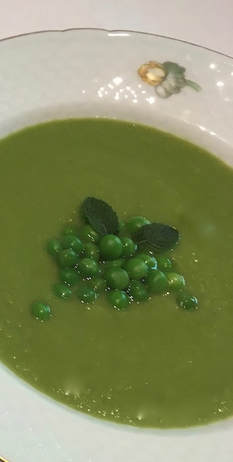 I like starting a dinner with soup. And of soup, there are various.
There’s cream soup – a combination puréed so smoothly that it’s cream-like. It may even contain cream. Needless to say, mine generally does. It has a silky mouth-feel (You might need to help it with a little thickening such as an egg yolk or roux). There’s consommé (ah, if only) – the most elegant are clear, perhaps with something delicate floating. It might be a simple chicken broth with a few floats of white meat. It could be a miso soup with silken tofu cubes or a Thai soup, clear, sweet and hot, dotted with herbs and straw mushrooms. There’s chunky soup – with nourishing bits in it like minestrone or a Swedish bean & pork hock soup, which could be a meal. Then there’s the dreaded thick soup or what I’ll politely call hippy soup, more like a thick gruel, so thick that a spoon could stand in it. This soup needs thinning. It is just not nice in the mouth. If you want the soup to be a meal, do chunky. If following a recipe slavishly, you may have to add more liquid like "tap stock" (i.e. water) or stock or cream. The travel writer Paul Theroux scathingly describes his mother’s cooking (in Mother Land) – “soup so thick a mouse could have trotted across it”. This is an image good enough to remind you to check your soup's consistency. |
Categories
All
|




 RSS Feed
